

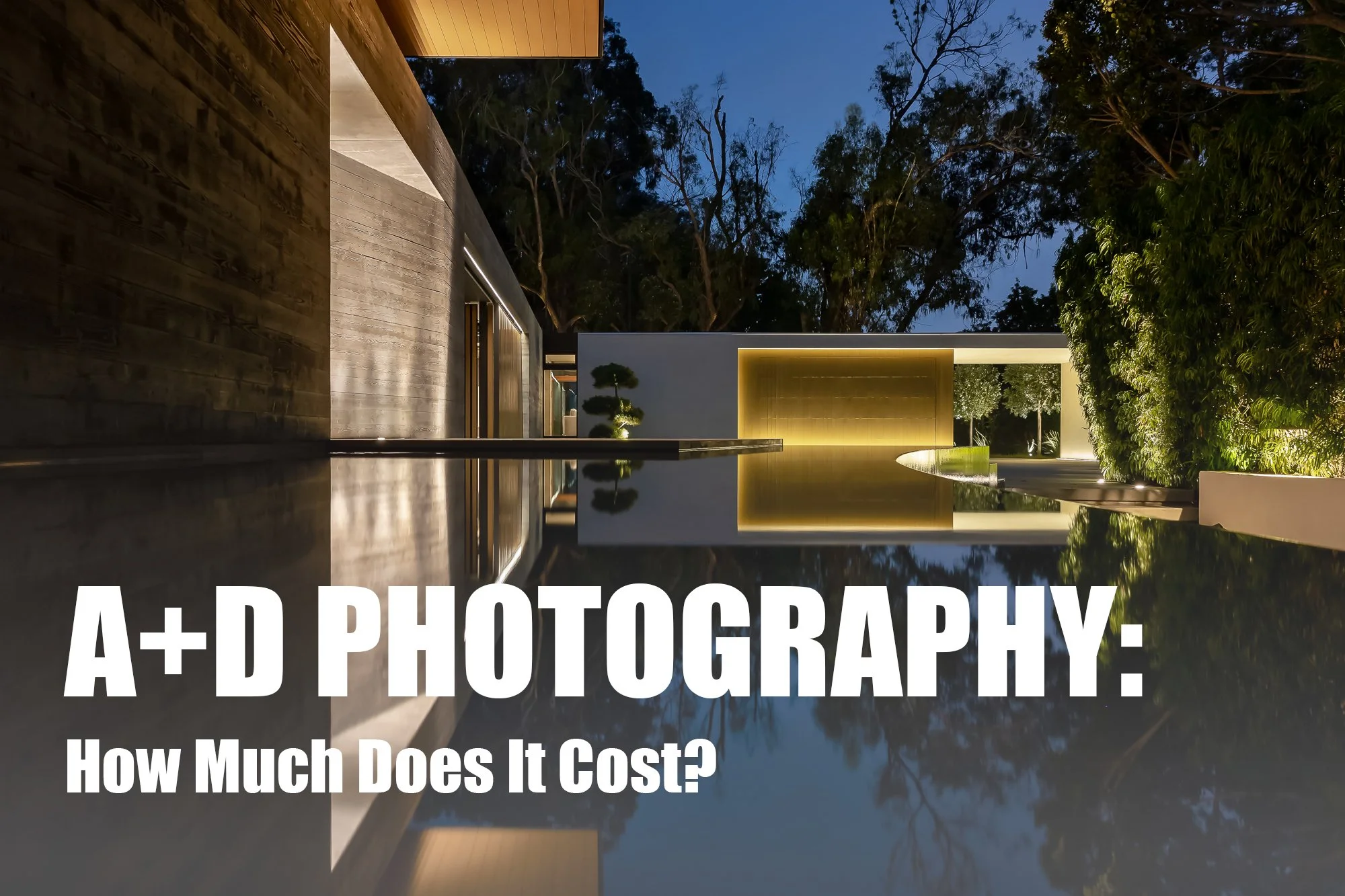
Editorial architecture and interior design photography of a modern residential project.
Social media, digital marketing, and online portfolios have changed how architecture and design firms attract and compete for clients. One thing hasn’t changed: great design still needs great imagery to sell it.
Whether your work lives on your firm’s website, is pitched to publications, submitted for awards, or used to win the next client, high-level Architecture & Design (A&D) photography directly shapes how your work is perceived. In a competitive market, strong visuals aren’t a luxury—they’re leverage.
Good photography doesn’t just show a space. It translates intent, clarifies design decisions, and positions your work at the level you want to be hired for next.
THE ROLE A&D PHOTOGRAPHY PLAYS IN YOUR BUSINESS
If your firm designs spaces—homes, commercial environments, hospitality projects, or public architecture—the photography of that work directly impacts your credibility, visibility, and future revenue.
Done well, A&D photography does more than document a finished project. It communicates intent. It translates design decisions. It helps the viewer understand why the space matters.
To put that into perspective, let’s look at a hypothetical scenario.
A HYPOTHETICAL SCENARIO
Before discussing cost, it’s important to understand that the term “architecture photography” can mean very different things depending on the goal.
Let’s imagine your firm has just completed a modern custom home—clean lines, thoughtful material choices, intentional light, and strong indoor-outdoor flow.
Now let’s look at two very different photographic approaches for that same project.
SCENARIO #1 – STRAIGHTFORWARD DOCUMENTATION
In this scenario, the goal is simple documentation.
The project is photographed cleanly and accurately. The images show room layouts, material finishes, and overall scale. The home is staged minimally, shot efficiently, and delivered as a concise set of images.
These photos work well for:
Project archives
MLS or basic marketing needs
Internal documentation
Quick website updates
They provide clarity and information. They do their job.
SCENARIO #2 – EDITORIAL, DESIGN-DRIVEN STORYTELLING
Now imagine a different goal.
This time, the project is photographed with editorial intent. The focus shifts from simply showing the space to communicating the design philosophy behind it.
Light is shaped intentionally. Angles are chosen to emphasize proportion and flow. Details are highlighted. Styling may be refined. Human presence might be introduced to give the space scale and life.
These images are created for:
Design publications
Awards submissions
Marketing campaigns
High-end websites and pitch decks
Long-term brand positioning
The space isn’t just documented, it’s interpreted.
SAME PROJECT. TWO VERY DIFFERENT SHOOTS.
Both scenarios result in “architecture photos.”
Only one of them is designed to elevate perception, build authority, and attract higher-level clients.
Naturally, they also come with very different production requirements, timelines, and costs.

Editorial architecture and interior design photography of a modern primary bathroom.
A&D PHOTOGRAPHY IS A VALUE-BASED SERVICE
Architecture and design photography is not priced by the square foot or the number of rooms. It’s priced based on what the imagery needs to accomplish.
Value is contextual.
A set of images used internally or for a short-term purpose has a very different value than imagery used:
To represent your firm publicly
To win future work
To live on your website for years
To be licensed across multiple platforms
The same project can have wildly different photographic value depending on how and where the images will be used.
SO… HOW MUCH DOES A&D PHOTOGRAPHY COST?
The honest answer is: it depends.
Just like architecture itself, there is no one-size-fits-all pricing model.
A small residential firm updating a portfolio page has different needs than a nationally recognized studio producing imagery for press, awards, and brand campaigns. Both require A&D photography, but the expectations and budgets are not comparable.
If you’ve ever Googled photography pricing, you’ve probably seen numbers all over the map. Many of them are misleading, incomplete, or detached from professional production realities.
A SIMPLE COMPARISON: REMODELING A SPACE
Asking how much architectural photography costs is similar to asking how much it costs to remodel a kitchen.
A contractor would ask:
Are we refinishing or replacing?
Stock cabinets or custom?
Basic appliances or top-tier?
Are we moving plumbing or walls?
Each decision affects the scope, time, and final cost.
Photography works the same way.
WHAT ACTUALLY DRIVES THE COST OF A&D PHOTOGRAPHY
Some of the biggest variables include:
Scope of the project
Number of spaces and complexity
Styling requirements
Time on site
Post-production needs
Licensing and usage
Experience and specialization of the photographer
Two projects that look similar on paper can have very different demands once intent and usage are defined.

Editorial architecture and interior design photography of a modern kitchen with an ocean view.
TYPICAL FEES IN PROFESSIONAL A&D PHOTOGRAPHY
While pricing varies, professional estimates often include:
Creative Fee / Day Rate
This covers time on site, technical expertise, creative decision-making, and project execution. For experienced A&D photographers, day rates commonly range from $1,500 to $5,000+, depending on scope and market.
Post-Production
This includes image selection, color work, perspective control, compositing, and refinement. High-end architectural imagery is rarely “straight out of camera.”
Expenses
Travel, assistants, styling elements, and production costs as needed.
Licensing / Usage
This reflects how and where the images will be used—website, social, print, press, advertising, or long-term brand use. Broader usage carries higher value.
WHY “CHEAP” A&D PHOTOGRAPHY IS A RISK
When pricing drops unrealistically low, something gives:
Time
Attention to detail
Technical consistency
Long-term reliability
High-level design work deserves imagery that represents it accurately and intentionally. Photography that undercuts professional standards often costs more in the long run—through re-shoots, missed opportunities, or diluted brand perception.
ALIGNING PHOTOGRAPHY WITH YOUR GOALS
The most successful A&D photography projects start with clarity.
What is this imagery meant to do?
Attract new clients?
Position your firm at a higher level?
Support PR and editorial?
Live on your website for years?
Once those goals are defined, the scope and budget can be aligned intelligently.
FINAL THOUGHT
If you’ve invested years into education, process, materials, and execution to create meaningful architecture or design, the photography should reflect that same level of intention.
Strong A&D photography isn’t about checking a box—it’s about translating your work into visual language that works for you long after the project is complete.
And when done right, it’s one of the most effective long-term investments your firm can make.
View selected architecture and design projects in my portfolio here.
©SandKasl Imaging